

10 Reasons Why We Can Live on Mars
Mars is harsh, cold, and nearly airless. Yet the scientific case for human habitation there is stronger than it might appear. These ten reasons lay out why long-term Mars colonization is physically possible.
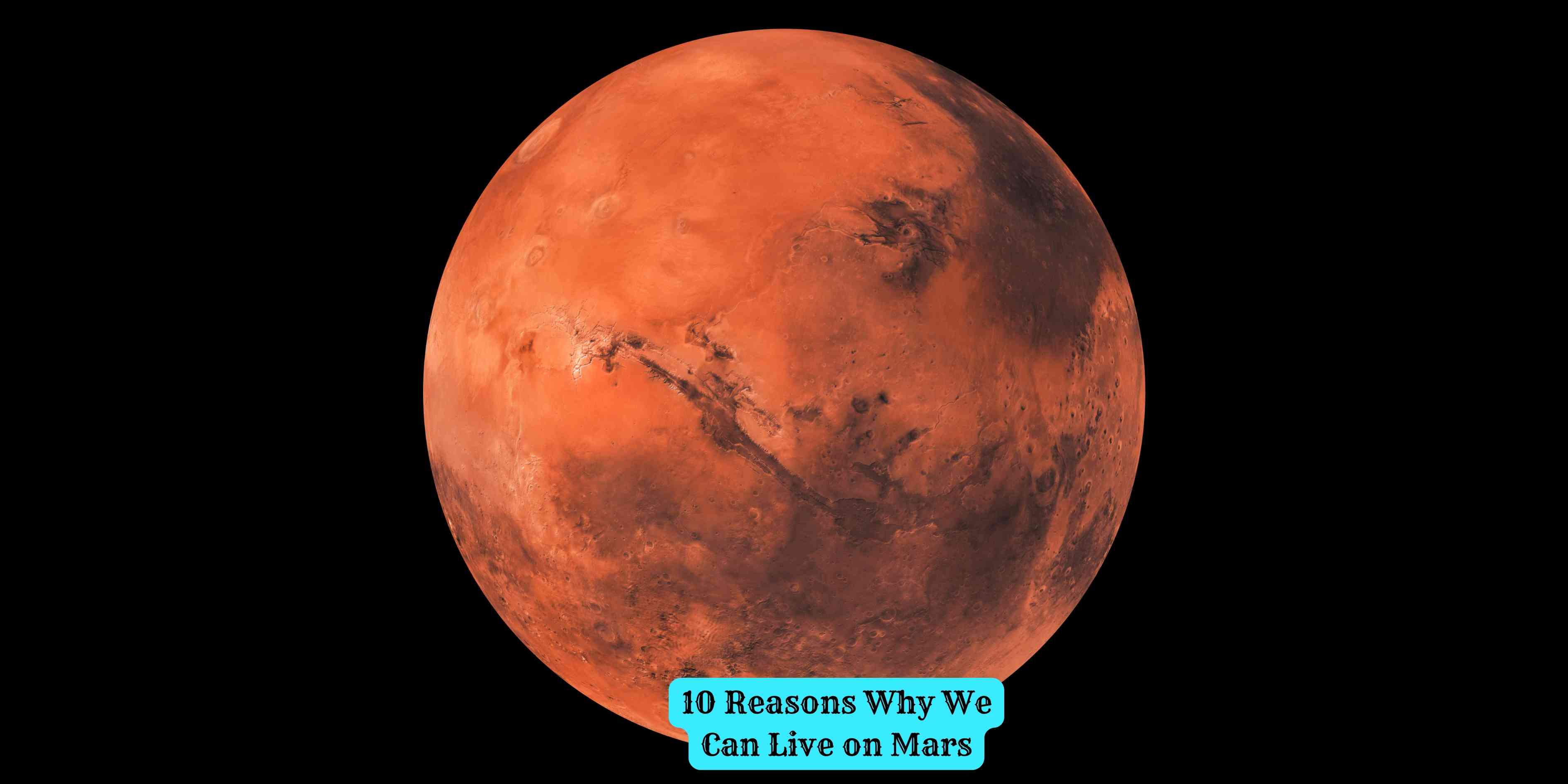
Mars presents enormous challenges for human habitation — a thin atmosphere, temperatures that average minus 60 degrees Celsius, high radiation levels, and the absence of breathable air or liquid surface water. But it also has resources, conditions, and characteristics that make long-term human habitation more feasible than any other planetary body in our solar system beyond Earth. These ten reasons present the scientific and technological case for why Mars colonization is possible rather than merely speculative.
1. Mars Has Water — In Significant Quantities
Mars has water ice at its polar ice caps, water ice mixed into its soil (regolith) across much of its surface, and evidence of liquid water below the Martian surface in the form of subsurface brines. The Martian soil has been found to contain between 2% and 10% water by weight in certain regions, which can be extracted through heating. Water is the single most critical resource for human habitation — for drinking, for producing oxygen through electrolysis, and for producing hydrogen fuel. Its availability on Mars makes habitation possible in a way that it would not be on a completely dry body.
2. Mars Has a Day Length Similar to Earth’s
A Martian day (sol) is 24 hours and 37 minutes — strikingly close to the Earth day that human circadian rhythms are calibrated to. This means that crops can be grown on a near-Earth light cycle, that human biological rhythms can function with minimal disruption, and that schedule-based operations can follow familiar patterns. This is a significant advantage over deep space stations or lunar habitation, where the light cycle is dramatically different from the human biological standard.
3. Mars Has Enough Gravity to Support Human Health
Mars has approximately 38% of Earth’s gravity — significantly higher than the near-zero gravity of space stations or the lunar surface (17% of Earth gravity). While Mars gravity is lower than Earth’s and long-term health effects remain uncertain, it is sufficient to allow fluids to stay in tissues, to prevent the most severe cardiovascular and bone-density loss effects of microgravity, and to allow colonists to walk and work without specialized countermeasures. Of all potential habitation sites, Mars offers the most Earth-like gravity environment outside Earth itself.
4. Oxygen Can Be Produced from the Martian Atmosphere and Soil
The Martian atmosphere is 95% carbon dioxide. Carbon dioxide can be electrolytically split into oxygen and carbon monoxide, and the oxygen collected for breathing. NASA’s MOXIE experiment, which flew on the Perseverance rover, demonstrated oxygen production from the Martian atmosphere in 2021 — proof of concept that this approach works in actual Martian conditions. Oxygen can also be extracted from water ice through electrolysis. Mars thus has two available pathways to oxygen production without bringing it from Earth.
5. Mars Has a 24-Hour Martian Light Cycle Suitable for Agriculture
With access to water and CO2 (both available on Mars), the only other major requirement for plant growth is light. While Martian sunlight is approximately 40% of the intensity at Earth’s surface (due to greater distance from the Sun), research on plant growth under reduced light intensity suggests that many crops can grow adequately under these conditions — and supplemental LED lighting in habitats can compensate. Closed-environment hydroponic or aeroponic agriculture in pressurized habitats is the most likely initial agriculture approach and has been extensively researched.
6. Underground Habitats Can Provide Radiation Protection
Mars lacks a global magnetic field, and its thin atmosphere provides minimal protection from cosmic radiation and solar particle events. Surface radiation on Mars is approximately 100 times higher than on Earth’s surface. However, this problem has a straightforward engineering solution: underground habitats. Placing living quarters beneath even a meter or two of Martian regolith reduces radiation exposure to manageable levels. The Martian subsurface provides natural radiation shielding without requiring materials brought from Earth.
7. Mars Has a Documented Geological History That Supports Habitability
Mars was once a warmer, wetter planet with a thicker atmosphere — the evidence includes ancient river valleys, lakebeds, and mineral deposits that require liquid water to form. This history suggests that Mars has the fundamental chemistry to support at least microbial life, and possibly more complex biological processes, in appropriate conditions. The presence of perchlorate salts, organic molecules (detected by Curiosity), and varied mineralogy means that Mars has the chemical raw materials that biological systems can work with.
8. Mars Has Abundant Raw Materials for Construction
The Martian regolith contains silicon, iron, aluminum, magnesium, and other elements that can be used for construction. Compressed regolith — essentially Martian soil bricks — has been identified as a practical building material. 3D printing with regolith-based materials has been demonstrated on Earth as a feasible approach to constructing Martian surface structures. This means that early colonists would not be limited to materials brought from Earth but could build with what is available on the Martian surface.
9. The Transit Distance Is Manageable with Current Technology
Mars is between 54 and 401 million kilometers from Earth depending on orbital positions. Current propulsion technology (chemical rockets) can achieve transit times of approximately 6-9 months for crewed missions during favorable launch windows. SpaceX’s Starship is designed specifically for Mars transit and has been developed with Martian colonization as an explicit mission goal. Unlike more distant outer planets, Mars is reachable with existing propulsion approaches — and more advanced propulsion development would reduce transit time further.
10. Mars Is the Most Earth-Analogous Destination Available
Of all the potential places in the solar system where humans might establish a permanent presence beyond Earth, Mars is the most Earth-like in the most ways that matter: day length, gravity, available resources, surface solid ground, and atmospheric chemistry that can be worked with. None of the alternatives — the Moon, asteroids, the moons of Jupiter or Saturn — are as favorable across this combination of factors. When the cumulative case for Mars is evaluated against all other destinations, Mars emerges as by far the most practical candidate for the first permanent human settlement beyond Earth.