

5 characteristics of civilization
The main characteristics of civilization include cities, organized government, shared beliefs, social classes and job specialization, and advanced culture such as writing and technology.
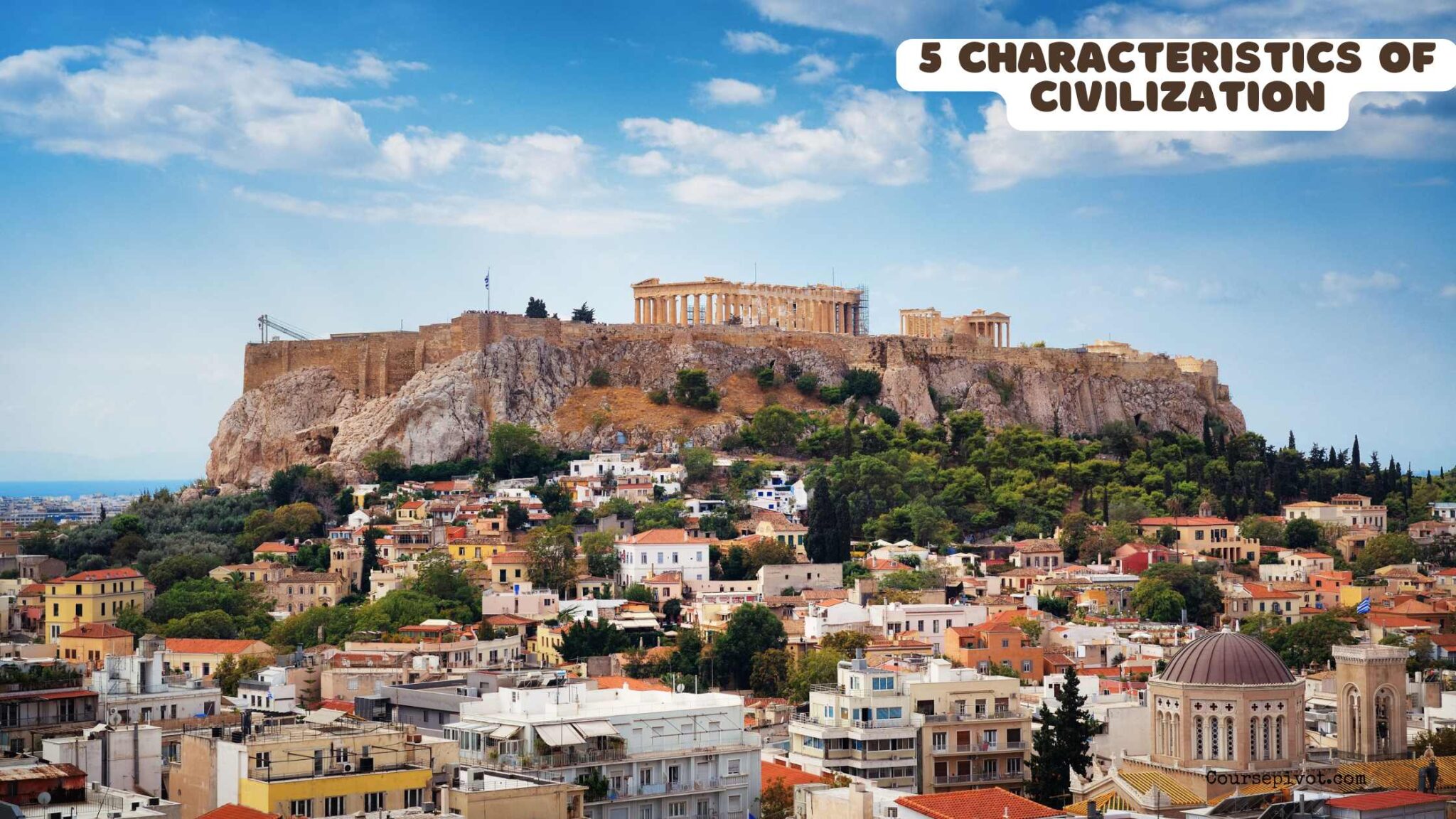
A civilization is a complex human society with organized ways of living, governing, working, worshiping, building, recording information, and passing culture from one generation to another. Civilizations are more advanced than small bands or simple villages because they have larger populations, specialized roles, institutions, and shared systems that organize daily life.
Historians often use certain characteristics to decide whether an ancient society can be described as a civilization. Different textbooks may list the traits slightly differently, but the main ideas are usually similar.
The 5 characteristics of civilization are cities, organized government, religion or shared beliefs, social structure and job specialization, and advanced culture such as writing, technology, and art.
| Characteristic | What It Means |
|---|---|
| Cities | Large permanent settlements where many people live and work. |
| Organized government | Leaders, laws, and systems for making decisions and keeping order. |
| Religion or shared beliefs | Common spiritual, moral, or cultural ideas that unite the society. |
| Social structure and job specialization | Different classes, roles, occupations, and responsibilities. |
| Advanced culture | Writing, technology, art, architecture, education, and recordkeeping. |
Cities
Cities are one of the clearest characteristics of civilization. A city is more than a group of houses. It is a permanent settlement with many people, public spaces, markets, religious centers, workshops, roads, storage areas, and organized activity.
Early civilizations often grew near rivers because rivers provided water, fertile soil, transportation, fish, and trade routes. Examples include Mesopotamia near the Tigris and Euphrates Rivers, Egypt near the Nile, the Indus Valley near the Indus River, and early Chinese civilization near the Yellow River.
Cities allowed people to live and work together in larger numbers. They also created the need for planning, leadership, defense, sanitation, food storage, and trade. This is why geography is so important in history. You can connect this idea with the five themes of geography, especially location, place, and human-environment interaction.
Organized Government
Civilizations need government because large populations cannot function well without rules, leadership, and decision-making systems. Governments create laws, collect taxes, organize workers, settle disputes, plan public projects, and protect the society from threats.
In ancient civilizations, government could take many forms. Some societies were ruled by kings, emperors, priests, councils, nobles, or military leaders. Others developed more complex bureaucracies with officials who helped manage land, taxes, trade, and records.
Government can be fair or unfair, strong or weak, democratic or authoritarian. The key point is that civilization requires some organized system of authority. For a related civics topic, read 5 characteristics of oligarchy to see how power can become concentrated in the hands of a few.
Religion or Shared Beliefs
Religion and shared beliefs helped early civilizations explain the world, create moral rules, unite communities, and support political authority. Many ancient civilizations built temples, pyramids, shrines, altars, or sacred spaces as part of public life.
In some societies, religious leaders had major political influence. In others, kings claimed divine approval or were seen as connected to the gods. Religious festivals, rituals, burial practices, myths, and moral codes helped people understand their place in the universe.
Shared beliefs do not always have to be religious in the modern sense. A civilization may also be held together by common values, traditions, laws, stories, customs, symbols, and ideas about right and wrong.
Social Structure and Job Specialization
Civilizations develop social structure, meaning people have different ranks, roles, and responsibilities. Some people may be rulers, priests, merchants, farmers, artisans, soldiers, scribes, builders, servants, or enslaved people.
Job specialization happens when people focus on different types of work instead of everyone doing the same basic survival tasks. One person may farm, another may make pottery, another may build tools, and another may keep records. This specialization makes society more productive and complex.
Social structure can create stability, but it can also create inequality. Some people gain wealth, education, and status, while others have fewer rights or opportunities. Understanding social structure helps students see how civilizations organize both cooperation and power.
Advanced Culture, Writing, and Technology
Civilizations usually develop advanced culture, including writing, art, architecture, technology, education, law, literature, mathematics, and science. Writing is especially important because it allows people to keep records, pass down laws, manage trade, collect taxes, preserve stories, and communicate across time.
Examples include cuneiform in Mesopotamia, hieroglyphics in Egypt, early writing systems in China, and recordkeeping in other ancient societies. Writing helped governments and economies become more organized.
Technology also mattered. Irrigation systems, calendars, metal tools, wheels, ships, roads, and building techniques allowed civilizations to grow. Art and architecture showed identity, power, religion, and creativity.
Why Civilizations Develop
Civilizations usually develop when people have enough food, water, resources, organization, and security to support larger populations. Farming was especially important because it created food surpluses. When not everyone had to farm all the time, some people could specialize in other jobs.
Trade also encouraged civilization. When communities exchanged goods, ideas, tools, and knowledge, they became more connected and complex.
However, civilizations also face problems such as inequality, war, disease, environmental damage, resource shortages, and political conflict. Studying civilization is not only about achievements; it is also about understanding how societies rise, adapt, and sometimes decline.
Civilization vs Culture
Culture refers to the beliefs, customs, art, language, food, clothing, music, values, and daily practices of a group of people. Civilization is a broader term that usually refers to a complex society with cities, government, social structure, and advanced institutions.
All civilizations have culture, but not every culture is classified as a civilization in the historical sense. Small societies can have rich cultures without having large cities or complex government systems.
This distinction helps students avoid thinking that civilization means a society is “better” than another. It simply means the society has certain levels of complexity and organization.
Final Thoughts
The 5 characteristics of civilization are cities, organized government, religion or shared beliefs, social structure and job specialization, and advanced culture such as writing, technology, and art.
These traits help historians understand how human societies became larger, more organized, and more complex over time.
Civilizations are important because they shaped law, government, writing, religion, trade, technology, architecture, and many ideas that still influence the modern world.