

Charles Darwin’s Contribution to Biology: The Theory of Evolution
Charles Darwin’s greatest contribution to biology was explaining how evolution happens through natural selection, changing how scientists understand life.
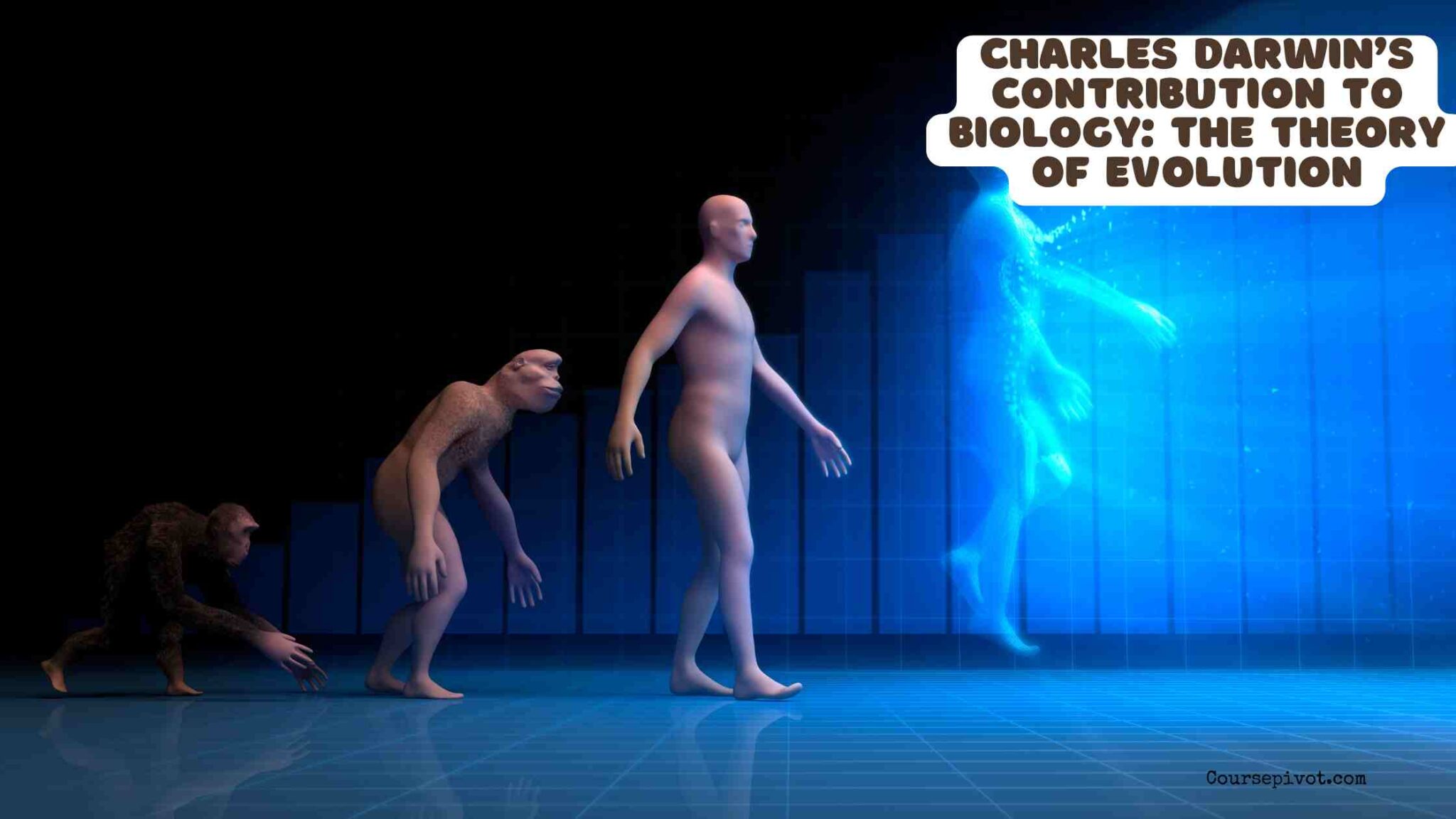
Charles Darwin’s contribution to biology was enormous because he gave science a powerful explanation for how living things change over time. Before Darwin, many people observed that species seemed related, adapted, and different across places, but there was no widely accepted natural mechanism explaining why.
Darwin’s major idea was evolution by natural selection. He argued that species are not fixed forever. Instead, populations change over generations when individuals with useful inherited traits survive and reproduce more successfully than others.
Charles Darwin’s greatest contribution to biology was explaining evolution through natural selection, a process that shows how species adapt, diversify, and change over time.
Who Was Charles Darwin?
Charles Darwin was a British naturalist born in 1809. He is best known for his book On the Origin of Species, published in 1859.
Darwin studied plants, animals, fossils, geology, breeding, and variation in nature. His thinking was shaped strongly by his voyage on HMS Beagle from 1831 to 1836, during which he observed species in South America, the Galapagos Islands, and other regions.
He did not invent the idea that species might change. Earlier thinkers had suggested forms of evolution. Darwin’s key contribution was explaining a convincing mechanism: natural selection.
What Darwin Meant by Evolution
In biology, evolution means change in inherited traits within populations over generations. It does not mean that one individual animal transforms into another kind of animal during its lifetime.
Evolution happens at the population level. If certain traits become more common over many generations, the population has evolved.
For example, if insects with coloring that blends into their environment survive more often and reproduce more, that coloring may become more common in the population over time.
This is why evolution is connected to inheritance, reproduction, variation, and environment.
Natural Selection Explained
Natural selection is the process Darwin used to explain how evolution happens.
The basic idea has four parts:
| Step | Meaning |
|---|---|
| Variation | Individuals in a population are not identical. |
| Inheritance | Some differences can be passed from parents to offspring. |
| Competition | More individuals are often born than can survive. |
| Differential survival and reproduction | Individuals with helpful traits leave more offspring. |
Over time, helpful inherited traits become more common. Harmful traits may become less common. Neutral traits may remain, disappear, or change in frequency by chance.
Natural selection does not have a plan. It does not try to make organisms perfect. It simply favors traits that help organisms survive and reproduce in a particular environment.
Darwin’s Evidence
Darwin gathered evidence from many areas of biology and natural history.
He studied:
- Fossils that showed extinct organisms
- Geographic distribution of species
- Similarities among related organisms
- Variation within species
- Artificial selection by breeders
- Adaptations in plants and animals
- Island species that differed from mainland relatives
Artificial selection was especially important. Humans had long bred pigeons, dogs, crops, and livestock for desired traits. Darwin reasoned that if human selection could change species over generations, natural environmental pressures could also shape populations over time.
The Galapagos Islands became famous in later discussions of Darwin because island species showed patterns of similarity and difference that made sense through descent and adaptation.
Why Natural Selection Changed Biology
Darwin’s theory changed biology because it gave scientists a unifying explanation for the diversity of life.
Natural selection helps explain:
- Why organisms are adapted to their environments
- Why related species share similarities
- Why species differ across islands and continents
- Why fossils show forms different from modern organisms
- Why domesticated species can change through breeding
- Why populations can become resistant to diseases, pesticides, or antibiotics
Evolution gave biology a framework. Instead of studying each organism as an isolated design, scientists could ask how traits developed, what pressures shaped them, and how species are related.
This is why evolution is often called a central organizing idea in biology.
Common Misunderstandings About Darwin
Darwin’s theory is often misunderstood.
One mistake is saying humans evolved from modern monkeys. Darwin did not argue that. Modern humans and modern apes share common ancestors, but one did not descend from the other in its present form.
Another mistake is thinking evolution means progress toward perfection. Evolution does not always make organisms stronger, smarter, or more complex. It only changes populations in relation to survival and reproduction in specific environments.
A third mistake is thinking natural selection is the only evolutionary process. It is extremely important, but modern evolutionary biology also includes mutation, genetic drift, gene flow, sexual selection, and other mechanisms.
Darwin and Modern Genetics
Darwin did not know about DNA. He did not understand genes in the modern sense. Gregor Mendel’s work on inheritance was not widely recognized until after Darwin’s lifetime.
Modern biology later connected Darwin’s natural selection with genetics. This became part of what scientists call the modern evolutionary synthesis.
Today, scientists understand that inherited variation comes from genetic differences. Mutations, recombination, and gene flow create or move variation. Natural selection can then act on that variation when it affects survival or reproduction.
This connection between evolution and genetics helps explain topics such as antibiotic resistance, inherited traits, species relationships, and biodiversity.
Examples of Evolution in Biology
Evolution is not only about ancient fossils. It can be observed in living populations.
Examples include:
- Bacteria evolving resistance to antibiotics
- Insects evolving resistance to pesticides
- Viruses changing over time
- Island species adapting to local environments
- Plants adapting to pollinators
- Animals developing camouflage in particular habitats
Bacteria are especially useful for studying evolution because they reproduce quickly. If you need a refresher on bacterial structure, see the guide on whether bacteria are prokaryotic or eukaryotic.
Evolution also helps explain ecological problems such as invasive species, because organisms entering a new environment may face different competitors, predators, diseases, and selection pressures.
Why Darwin Still Matters
Darwin still matters because evolution remains essential to modern biology, medicine, agriculture, conservation, and ecology.
His ideas help scientists understand:
- How diseases change
- Why antibiotic resistance develops
- How species are related
- Why biodiversity matters
- How organisms adapt to environments
- How conservation decisions affect populations
- Why artificial selection changes crops and animals
In medicine, evolution helps explain why pathogens can become harder to treat. In agriculture, it helps explain pesticide resistance. In conservation, it helps explain why genetic diversity matters for species survival.
Darwin’s work did not answer every question, but it changed the questions biology could ask.
Evolution as a Scientific Theory
In everyday speech, the word theory can mean a guess. In science, a theory is a broad explanation supported by evidence.
The theory of evolution is scientific because it explains observations, makes predictions, and is supported by evidence from fossils, anatomy, genetics, biogeography, embryology, ecology, and direct observation.
The theory has also grown since Darwin. Modern evolutionary biology includes discoveries Darwin could not have known, especially DNA, genetics, and molecular biology.
That is how science works. A strong theory is not frozen in time. It becomes more detailed as new evidence is discovered.
Final Thoughts
Charles Darwin’s contribution to biology was explaining how evolution can happen through natural selection. His work showed that species change over generations and that adaptation can arise from ordinary natural processes.
Darwin’s theory transformed biology by connecting fossils, species distribution, anatomy, adaptation, and diversity into one explanatory framework.
Modern science has expanded Darwin’s ideas with genetics and molecular biology, but the core insight remains powerful: life changes over time, and natural selection is one of the main processes shaping that change.