

How a Step-Down Transformer Makes Electricity Safe for Homes
A step-down transformer makes electricity usable at home by reducing high distribution voltage to a lower household voltage.
The Short Answer
A step-down transformer makes electricity safer for homes by reducing high-voltage electricity to a much lower voltage that household wiring and appliances are designed to use. Power travels more efficiently at high voltage over long distances, but homes need lower voltage for everyday use.
The U.S. Energy Information Administration explains that transformers increase or reduce voltage at different stages of electricity delivery. A step-down transformer is the part of the system that turns dangerous high voltage into practical household voltage.
Why Electricity Travels at High Voltage
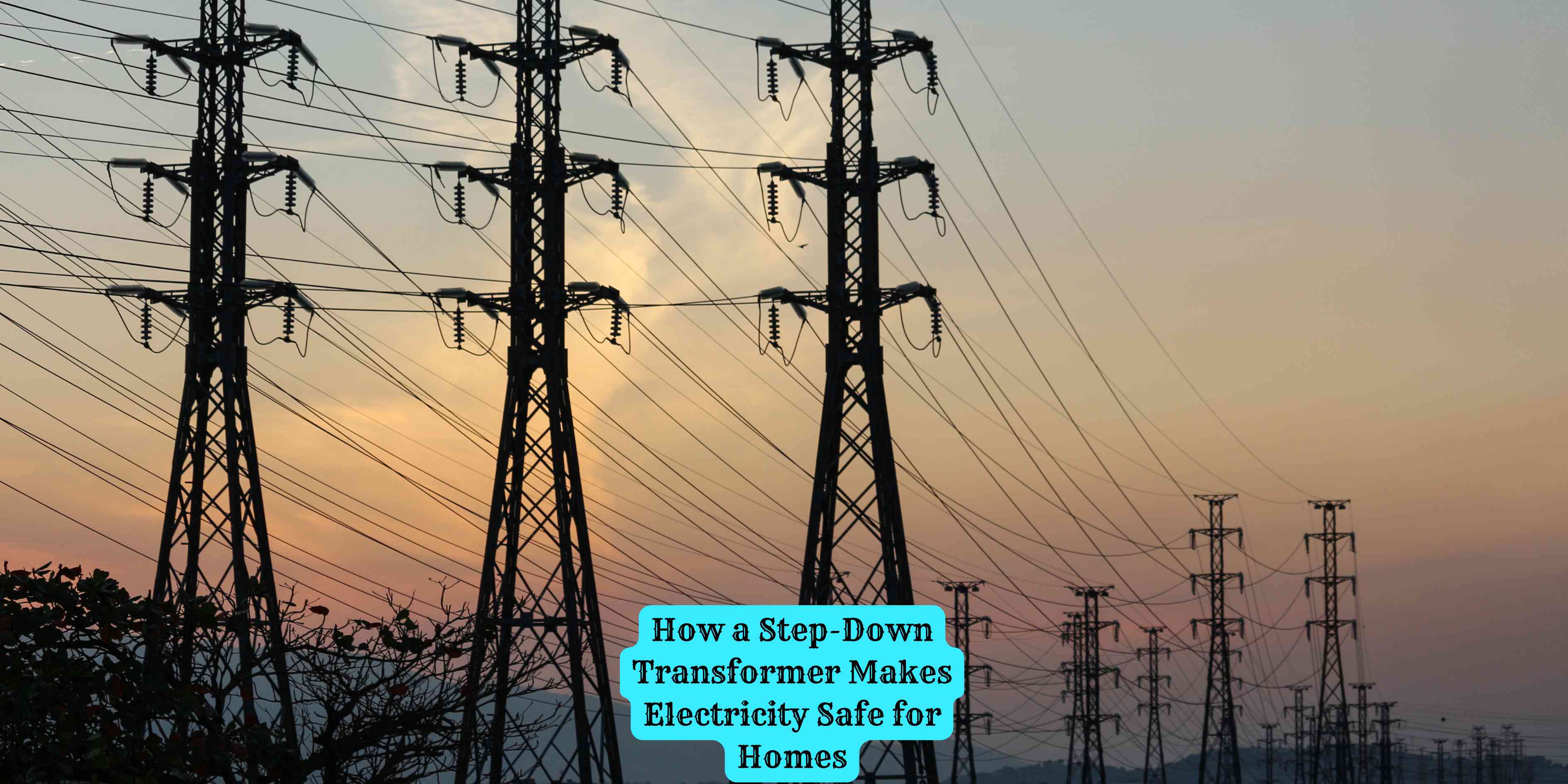
Electricity often travels from power plants through transmission lines at very high voltages. High voltage helps reduce energy loss during long-distance transmission. If electricity were sent long distances at low voltage, much more energy would be wasted as heat in the wires.
This creates a problem: the voltage that is efficient for transmission is not safe or suitable for homes. Household appliances, outlets, light fixtures, and electronics are built for lower voltage levels.
That is where transformers come in.
What a Transformer Does
A transformer changes voltage in an alternating current circuit. It does this using electromagnetic induction between coils of wire.
A basic transformer has:
- A primary coil
- A secondary coil
- An iron core
- Alternating current
When alternating current flows through the primary coil, it creates a changing magnetic field in the core. That changing magnetic field induces voltage in the secondary coil.
Why It Is Called Step-Down
A step-down transformer lowers voltage. It does this because the secondary coil has fewer turns of wire than the primary coil.
In simple terms:
| Transformer type | What it does | Common use |
|---|---|---|
| Step-up transformer | Raises voltage | Long-distance transmission |
| Step-down transformer | Lowers voltage | Local distribution and homes |
If the primary side has many turns and the secondary side has fewer turns, the output voltage is lower than the input voltage.
How Lower Voltage Protects Homes
High voltage can damage appliances, overheat wiring, create shock hazards, and increase fire risk. Household electrical systems are designed around specific voltage ranges and safety standards.
A step-down transformer helps by delivering electricity at a level that home circuits can handle. In the United States, many household outlets provide about 120 volts, while larger appliances may use 240 volts. Other countries use different standard household voltages, but the principle is the same: high distribution voltage must be reduced before ordinary use.
Why Current Changes Too
Transformers change voltage and current together. When voltage is stepped down, current can increase, depending on the load. This follows the principle that power is related to voltage and current.
However, the transformer does not make electricity “safe” by itself in every sense. Homes also need circuit breakers, fuses, grounding, insulation, outlet design, and electrical codes.
The transformer reduces voltage to a usable range. Other safety systems help prevent overloads, shocks, and fires.
Where Step-Down Transformers Are Found
Step-down transformers may be located at substations, on utility poles, in green pad-mounted boxes, or in other parts of the local distribution system. Their job is to bring voltage down closer to the level homes and businesses need.
You may have seen a cylindrical transformer on a utility pole near houses. In many neighborhoods, those devices help reduce voltage before electricity enters homes.
In underground systems, a transformer may sit in a locked box at ground level.
What Would Happen Without One
Without step-down transformers, homes would receive electricity at voltage levels far too high for ordinary appliances and wiring. Devices could fail instantly, insulation could break down, and the risk of electric shock or fire would be severe.
High voltage is useful in the right part of the grid, but dangerous in the wrong place. The transformer helps place the right voltage at the right stage.
The Main Idea
A step-down transformer makes electricity safe for homes by lowering voltage from the high levels used in transmission or distribution to the lower levels used by household circuits. It works through electromagnetic induction and coil ratios.
The result is a practical compromise: high voltage for efficient travel, lower voltage for everyday use.