

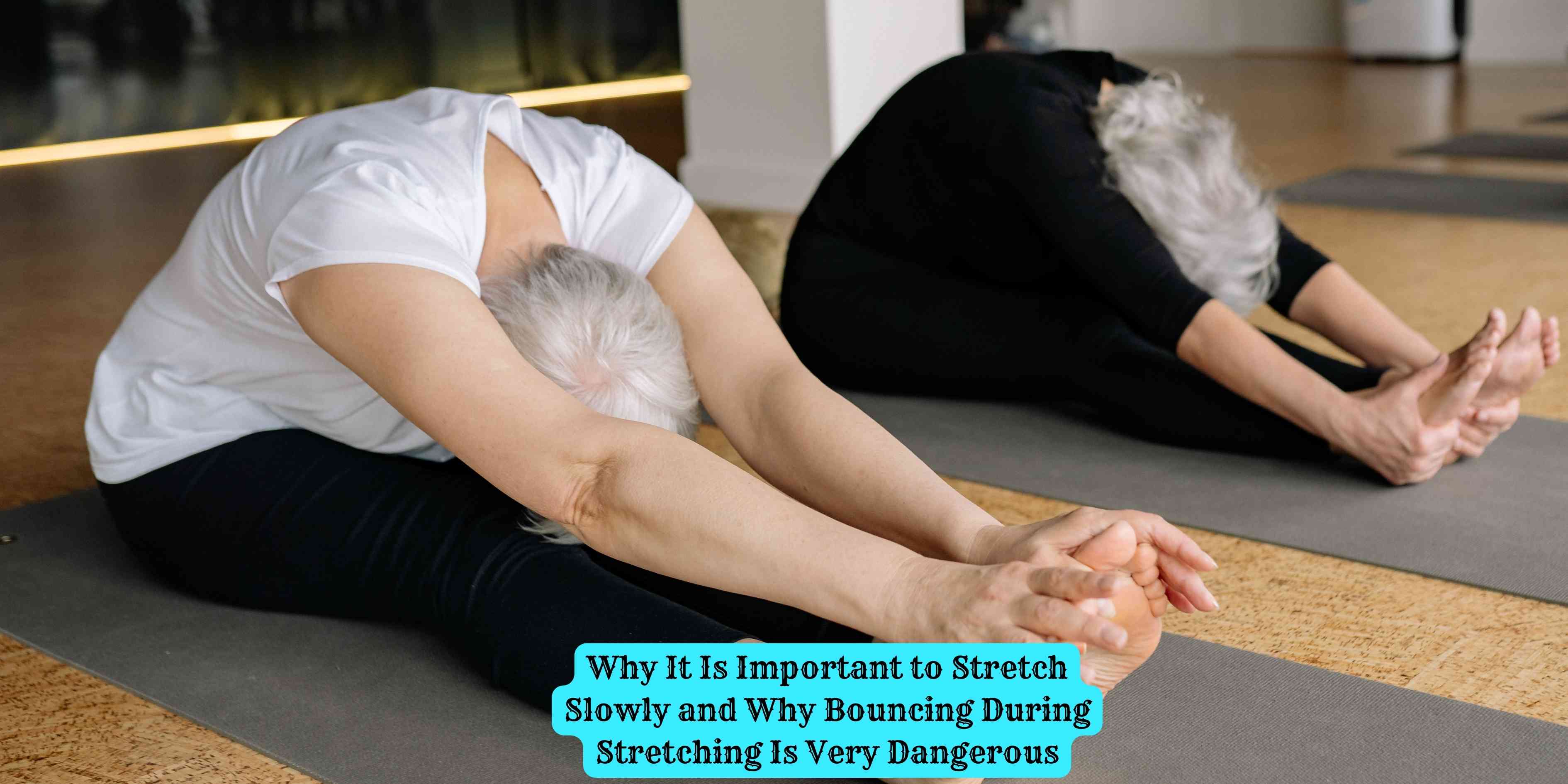
Why It Is Important to Stretch Slowly and Why Bouncing During Stretching Is Very Dangerous
The instruction to stretch slowly and avoid bouncing is not arbitrary caution. It has a specific physiological basis — and understanding it makes the instruction both more convincing and easier to follow.
The Short Answer
The instruction to stretch slowly and avoid bouncing (called ballistic stretching) is grounded in the physiology of the stretch reflex — a protective mechanism in which muscles automatically contract in response to sudden, rapid elongation. Slow stretching works with this reflex; bouncing triggers it. When a muscle contracts while being forcibly stretched, the result can be micro-tears in the muscle fibers and surrounding connective tissue. The safe, effective alternative is static stretching — gradual, sustained elongation held for 15 to 60 seconds — which allows the reflex to relax and produces genuine improvement in flexibility without injury risk.
The Stretch Reflex — Why Bouncing Is Dangerous
Inside each muscle are sensory structures called muscle spindles — specialized receptors that monitor the length and rate of change of the muscle. Muscle spindles are highly sensitive to sudden, rapid stretching. When they detect a fast elongation of the muscle, they send an immediate signal to the spinal cord, which responds by activating the motor neurons that cause the muscle to contract. This is the stretch reflex (or myotatic reflex), and it is a protective mechanism: the automatic contraction prevents the muscle from being stretched past the point it can safely accommodate.
The stretch reflex is a protective response, not a problem with the individual. It is designed to prevent muscle tearing. Bouncing during stretching triggers this reflex repeatedly — forcing the muscle to stretch while it is simultaneously contracting in self-defense. That combination is exactly what causes injury.
The key characteristic of the stretch reflex is that it is triggered by the rate of change in muscle length, not simply by the degree of stretch. A slow, gradual elongation of the muscle — even to a considerable degree of stretch — activates the muscle spindles much less than a rapid change of the same degree. This is why slow stretching can achieve the same range of motion that bouncing would attempt, but without triggering the reflex.
Ballistic stretching (bouncing) at the end range of a stretch does exactly what triggers the reflex: it creates rapid, repeated changes in muscle length at the point where the muscle is already elongated and under tension. The reflex contraction in response to each bounce results in a muscle that is simultaneously stretched and contracting — a recipe for micro-tears in the muscle fibers and, in more severe cases, acute muscle strains or tears in the connective tissue.
What Happens When You Stretch Too Fast
When the stretch reflex fires during a ballistic stretch and the muscle contracts against the applied force, the force is distributed across the muscle fibers and their associated connective tissue (tendons, fascia). If this force exceeds the capacity of those structures to absorb it without damage, the result is micro-trauma: small tears in the muscle fibers or connective tissue.
A single bouncing stretch session may not produce noticeable injury — micro-tears can occur without acute pain, particularly in younger people with more elastic connective tissue. But the cumulative effect of repeated micro-trauma is inflammation, reduced flexibility, scar tissue formation, and elevated injury risk over time. The irony of ballistic stretching is that it often produces the opposite of its intended effect: reduced flexibility as the body’s protective responses to repeated micro-trauma stiffen the tissue.
Acute injury is also possible with ballistic stretching, particularly in people who are not well-warmed-up, who have pre-existing muscle tightness, or who are pushing into ranges of motion at the outer limits of their current flexibility. Hamstring strains, calf strains, and hip flexor injuries are among the most common acute injuries associated with aggressive ballistic stretching.
Why Slow Stretching Works
Slow, static stretching — holding a stretch at the point of mild tension for 15 to 60 seconds — works for several reasons that are each related to the physiology described above.
The stretch reflex relaxes with time. When a stretch is held at a given length without additional elongation, the muscle spindles reduce their firing rate after a few seconds. The reflex-driven muscle contraction diminishes, and the muscle relaxes into the stretch. This process is sometimes described as “letting the muscle breathe” into the stretch — what is actually happening is that the reflex is quieting as the sensory receptors adapt to the sustained length.
Golgi tendon organs promote relaxation. In addition to muscle spindles, muscles contain Golgi tendon organs — sensory receptors located at the muscle-tendon junction that respond to tension in the tendon. When a stretch is held long enough for tendon tension to accumulate, the Golgi tendon organs send signals that inhibit muscle contraction — a reflex called the inverse myotatic reflex or autogenic inhibition. This inhibition actually assists the stretch: the muscle receives a signal to relax, allowing greater elongation without resistance.
Connective tissue viscoelasticity. Muscle and connective tissue have viscoelastic properties — they behave somewhat like viscous fluids in that they gradually deform under sustained, low-level stress. A sustained gentle stretch allows this gradual deformation to occur without damage; a rapid, high-force stretch does not give the tissue time to deform gradually and instead risks exceeding its elastic limit.
Practical Safe Stretching Guidelines
The physiological basis for slow stretching translates into practical guidelines that reflect how the body’s protective systems work:
Warm up before stretching. Cold muscles are less elastic and more vulnerable to strain. Light aerobic activity for 5 to 10 minutes raises muscle temperature and increases the elasticity of connective tissue, reducing injury risk and improving the effectiveness of stretching.
Stretch to the point of mild tension, not pain. The point of tension without pain is where the stretch is occurring at a degree the tissue can accommodate. Pain during a stretch indicates that the reflex is being triggered or that the tissue’s limits are being exceeded — both signals to reduce the intensity of the stretch.
Hold each stretch for 15 to 60 seconds. This is sufficient time for the stretch reflex to quiet and for the autogenic inhibition reflex to contribute to muscle relaxation. Brief holds (under 10 seconds) do not provide sufficient time for these responses to develop.
Breathe throughout the stretch. Breath-holding creates tension that works against the goal of muscle relaxation. Slow, steady breathing during a stretch supports the relaxation the stretch is intended to produce.
These guidelines are not arbitrary caution — they are descriptions of how to work with the body’s protective mechanisms rather than against them. Slow stretching, held at mild tension, produces genuine flexibility improvements safely; bouncing stretching risks injury precisely because it is designed to override the mechanisms that protect the muscle from damage.