

100 Reasons Why Marriage Is a Bad Idea
Marriage is a beautiful institution that is also a legally binding contract with serious financial, emotional, and logistical consequences. Here are 100 reasons to think about it carefully before signing.
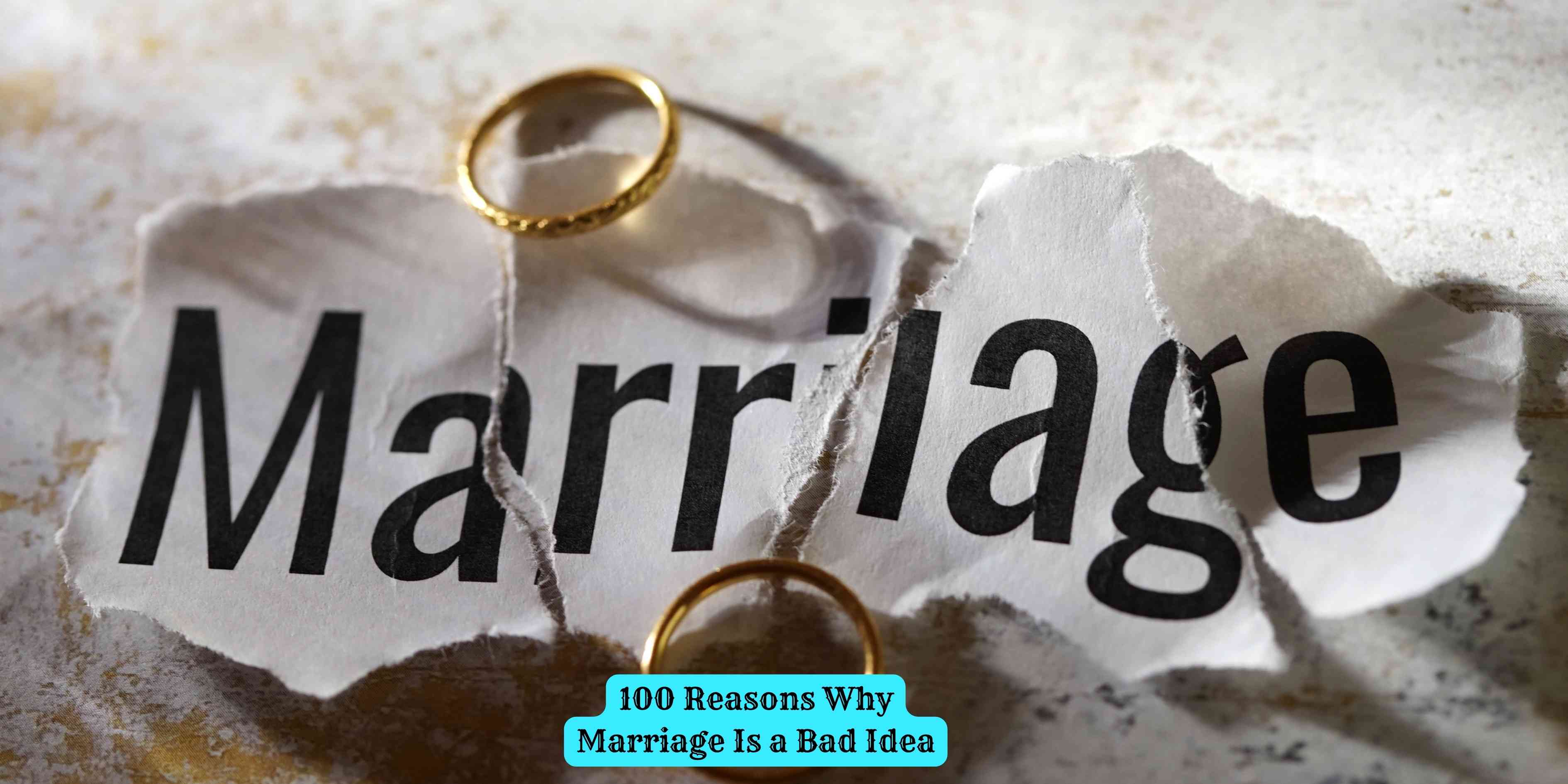
Marriage is not inherently a bad idea — but entering it without fully understanding its legal, financial, emotional, and logistical implications is. This list is not anti-marriage; it is a serious (and occasionally humorous) look at everything marriage asks of you, changes about your life, and involves that people rarely discuss during the part where everything feels romantic and good.
No one says “I do” thinking about divorce courts, joint debt liability, or in-law holiday schedules — but those things exist, and they will eventually be your problem if you do not think about them first.
Legal and Financial Risks
- Marriage creates joint financial liability — your partner’s debt can become your problem.
- Divorce is among the most expensive legal processes most people will ever go through.
- Marital property laws in many states make “what’s mine is mine” no longer accurate.
- Spousal support obligations can follow you for years after a marriage ends.
- Your credit can be affected by a partner’s financial behavior without your knowledge or consent.
- Prenuptial agreements, if absent, leave you with no negotiated terms if the marriage ends.
- Tax implications of marriage are not always favorable depending on your income structure.
- Joint accounts create shared vulnerability to financial mistakes.
- Inheritance becomes more complicated with a spouse, particularly in blended families.
- Equitable distribution in divorce can divide assets you earned independently.
- Health insurance dependencies can leave you without coverage if a marriage ends.
- Beneficiary designations become more complicated once a spouse exists legally.
Personal Freedom and Lifestyle
- Every major decision — where to live, whether to move, how to spend money — now requires a second vote.
- Your social calendar is no longer entirely your own.
- Spontaneity becomes logistically more complicated.
- Your home is now shared space, including the parts you preferred kept the way you had them.
- Your free time competes with shared obligations in a way it did not before.
- Travel becomes harder to arrange independently.
- Friendships require more scheduling effort when you share a household.
- Career opportunities that require relocation must now survive a two-person negotiation.
- Time alone — genuinely alone — becomes a resource that requires planning.
- Dietary preferences, sleep schedules, and temperature preferences are now shared problems.
- Your weekend is now co-authored.
- Watching what you want to watch, when you want to watch it, becomes a negotiation.
Emotional and Relational Realities
- You will see someone at their absolute worst every day, not just their best.
- The person you marry will change — and so will you — and those changes may not run parallel.
- Emotional labor in a long-term partnership is often distributed unequally.
- The romantic version of a person and the daily-life version are significantly different.
- Conflict over small things — dishes, driving, volume levels — is more frequent than conflict about big things.
- People who seemed easy-going while dating often have strong preferences about how the house is run.
- Disagreements about parenting are among the most difficult conflicts couples navigate.
- Your partner’s bad moods affect your household mood whether you want them to or not.
- Managing each other’s stress and emotional needs is a full-time additional job.
- Long-term intimacy requires maintenance that does not happen automatically.
- Resentment builds from small things over time more reliably than from large ones.
- You will have the same argument in slightly different forms for years.
Compatibility and Expectation Risks
- What you know about a person before living with them is incomplete in ways you cannot predict.
- People are on their best behavior during courtship in ways they cannot maintain indefinitely.
- Lifestyle incompatibilities that seem minor when dating become significant when shared daily.
- Different expectations about family visits create recurring tension.
- Differences in social energy — one introvert, one extrovert — require constant negotiation.
- Religious and value differences that seemed manageable in dating can intensify in daily life.
- Expectations about division of household labor are rarely explicitly discussed before marriage.
- Views on child-rearing are rarely fully explored before becoming relevant.
- Communication styles that work in low-stakes dating often struggle under real domestic pressure.
- Physical intimacy needs and expectations change over time for both people, often at different rates.
Practical Realities of Shared Life
- Someone else’s mess is now your environment.
- Another person’s family is now your family, including the parts that are difficult.
- You are responsible for someone else’s emotional wellbeing in a way no job description captures.
- Joint scheduling is a part-time job.
- In-law relationships are mandatory in a way they were not before.
- You cannot sell, move, or significantly change your major assets without a partner’s agreement.
- A partner’s health crisis is now your crisis.
- A partner’s career difficulties are now your financial concern.
- Household management in a shared space requires ongoing negotiation that never fully resolves.
- Pet preferences, storage habits, and organizational systems become joint decisions.
- Guest policies — who can stay, for how long — are now shared policy questions.
- Your professional reputation and social life become indirectly connected to your partner’s behavior.
Reasons That Are Mainly About the Wedding
- Weddings are extremely expensive for an event that lasts one day.
- Planning a wedding together is a genuine stress test of the relationship.
- Guest list decisions can create lasting tension with both families.
- The social pressure to have a certain kind of wedding costs people money they do not have.
- The fantasy of the wedding often receives more preparation than the reality of the marriage.
- Debt incurred for a wedding is still debt regardless of how romantic the occasion was.
- Post-wedding couple comparisons to the wedding version of yourselves are unrealistic.
Reasons to Think Twice Before Marrying the Wrong Person
- You cannot fully know someone until you have seen how they handle prolonged stress.
- Romantic love, without compatible values and shared goals, does not sustain a marriage.
- The pressure to marry by a certain age leads many people to marry the available person rather than the right person.
- Changing someone after marriage works less often than optimists predict.
- “I love them but…” is a complete sentence that deserves more attention before a wedding.
- The costs of ending the wrong marriage are higher than the costs of not beginning it.
- You cannot divorce your in-laws — only your spouse.
- What seems like a quirk during dating often becomes a source of friction in daily life.
Marriage, done right and entered thoughtfully, is one of the most meaningful things two people can do together. Done wrong, or for the wrong reasons, it is an expensive lesson delivered over several years. If you are weighing this decision seriously, top 5 reasons for divorce covers what tends to go wrong, while 100 reasons to stay married offers the counterpoint — all the things that make choosing a partner for life genuinely worth it.