

20 Bad Reasons to Get Divorced
Some marriages should end. Many divorces happen not because the marriage is beyond repair, but because the difficulty of repair looks too similar to impossibility.
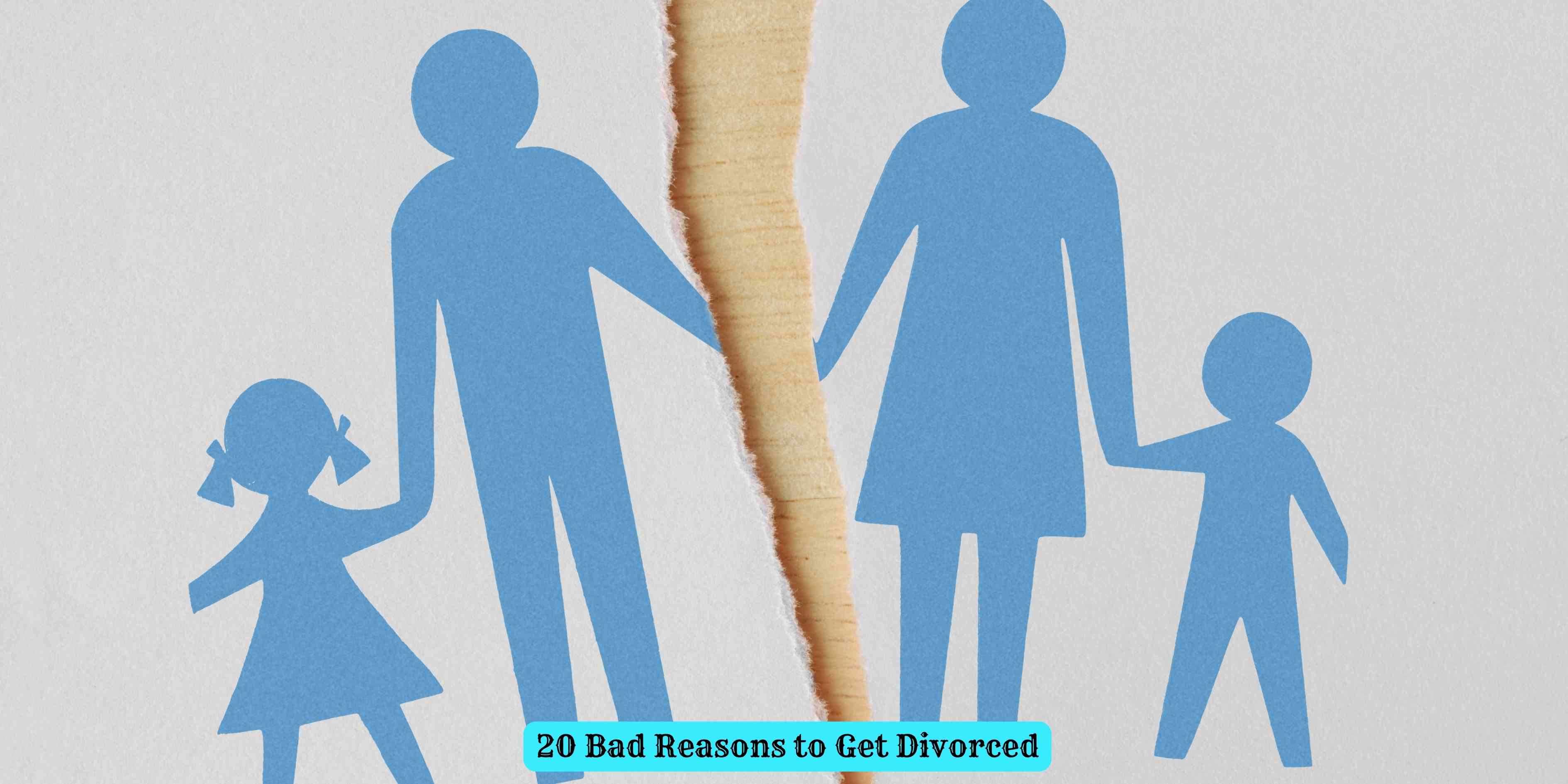
The reasons that warrant ending a marriage are real and serious — sustained abuse, betrayal with no remorse, abandonment, addiction with no willingness to change. But many divorces happen for reasons that are either temporary, resolvable with real work, or rooted in unrealistic expectations of what marriage is supposed to feel like. Knowing the difference is one of the most important things a married couple can do.
Feeling unhappy in your marriage is not the same as being in a bad marriage. Unhappiness in any long-term relationship is temporary, recurring, and survivable — if the underlying relationship is sound.
Temporary and Situational Reasons
1. You went through a difficult season and confused it for a permanent state. New parenthood, job loss, illness, grief, financial stress, moving, caring for aging parents — these are intensely hard on marriages. The relationship often becomes strained or even bleak during these periods. Many couples who divorce during or immediately after a crisis report later that the marriage, absent the crisis, had been solid. The right response to a hard season is usually not to exit.
2. You had one very bad year. Research on marital satisfaction shows that happiness in marriage is not static — it fluctuates substantially across years, with lows that can be genuinely alarming. Couples who stay together often report higher satisfaction five years later than at the point they seriously considered divorce. One terrible year is not necessarily the measure of the marriage.
3. The initial passion has faded. Romantic and sexual passion in marriage typically diminishes from its peak early-relationship intensity — this is biological and universal, not a sign that the relationship is broken. The transition from passionate love to companionate love is normal, and the second version of intimacy is often deeper and more sustainable than the first, even when it does not feel as urgent.
4. You are experiencing boredom in your life and attributing it to your marriage. People going through career dissatisfaction, loss of identity, or personal stagnation often experience a vague but powerful feeling that their life needs to change. This feeling can be projected onto the marriage, leading to an exit that does not solve the underlying problem. Individual therapy and honest self-reflection often reveal that the marriage is not the source.
5. You fought badly for a few months. Conflict in marriage is normal. Extended periods of elevated conflict are normal. Couples who eventually build strong relationships often report going through periods that would have looked, from the outside, like reasons to divorce. The presence of conflict is not evidence of incompatibility; the inability to repair after conflict is more significant.
Expectation-Based Reasons
6. Your spouse doesn’t make you happy all the time. No relationship makes anyone happy all the time. The premise that a spouse is responsible for your happiness as a constant state is a recipe for expecting the impossible and divorcing because reality differs from it. Personal happiness is primarily your own responsibility; a spouse can contribute to it but cannot be its sole source.
7. Someone else seems more exciting. Feelings of attraction to another person are normal throughout a marriage — they do not indicate that the marriage is over or that you are in the wrong relationship. Acting on them, or using their existence as evidence that your marriage is inadequate, is a different matter. The emotional intensity of a new connection is almost always a function of novelty, not a reflection of its actual depth.
8. Your spouse isn’t the person you thought they would be. Both spouses change substantially over the course of a long marriage. The person who marries you at 25 is different at 45 — and so are you. Expecting someone to remain the version of themselves you fell in love with, rather than becoming someone you learn to love in different ways, is an expectation that marriage will consistently fail to meet.
9. You feel like you married the wrong person. This feeling, common even in good marriages at various points, is not necessarily evidence that you did. It may be evidence that you are in a difficult period, or that you have stopped investing in knowing your partner, or that your own personal growth has outpaced your attention to the relationship. The right response is usually not divorce but recommitment to understanding who you are both becoming.
External Pressure and Influence Reasons
10. Your family or friends think you should leave. Other people’s assessments of your marriage are based on partial information, filtered through their own relational histories and biases. Family and friends who love you may give terrible marital advice because their understanding of your relationship is necessarily incomplete. This is your marriage, not theirs, and the decision should be made by the people inside it.
11. A social media comparison made your marriage look inadequate. Measuring your relationship against the highlight reel of other relationships is a reliable path to dissatisfaction. What other couples present publicly bears essentially no relationship to what they experience privately. Divorcing because of a comparison to an edited version of someone else’s life is not a sound basis for any decision.
12. You watched someone else end a mediocre marriage and seemingly become happier. Survivorship bias operates powerfully here. The people who visibly flourish after divorce are not representative of everyone who divorces. Many people discover after divorce that the problems they attributed to the marriage were within themselves, and are still there.
Laziness and Avoidance
13. Marriage counseling feels too hard or too uncomfortable. Marriage therapy is genuinely uncomfortable — it requires sustained honesty, vulnerability, and the willingness to hear things about yourself that are not flattering. Many couples who could have rebuilt their marriages exit before getting serious professional help because the process is difficult. Difficulty is not the same as impossibility.
14. The problems in your marriage are real but your approach to solving them hasn’t changed. Some couples spend years arguing about the same things in the same ways and conclude the problems are unsolvable, when what has not actually been tried is a fundamentally different approach: structured therapy, dedicated time, external accountability, or honest acknowledgment of what each person actually needs to change.
15. You want out because the relationship requires work and you are exhausted. Long marriages require sustained, sometimes significant work. Exhaustion with that work is real and should be taken seriously — but rest and recovery are different from exit. Emotional exhaustion that leads to divorce often has the same solution as exhaustion in other domains: stopping, recovering, and returning with different resources.
Unrealistic Premises
16. You think you will be happier after. Research on post-divorce happiness shows mixed results. People who leave genuinely abusive or destructive situations do tend to be happier; people who leave functional if imperfect marriages often report similar or lower wellbeing several years later. The grass is not reliably greener; sometimes it is just someone else’s lawn.
17. You think your children will be fine. Children are affected by divorce in ways that vary significantly by conflict level, age, parental cooperation, and other factors. In high-conflict marriages, divorce often benefits children. In lower-conflict marriages, children often do better when parents stay together and repair the relationship. The assumption that children will simply adapt should be tested against evidence, not assumed.
18. You want to find yourself. Personal growth and self-discovery do not require ending your marriage. What they require is attention, honest reflection, and sometimes therapy. The idea that your true self can only be found outside a committed relationship is a narrative that may feel compelling and may occasionally be true — but it is not as reliably true as it is often assumed.
19. Your sex life has diminished and you have not addressed it. Reduced sexual frequency and satisfaction in marriage is extremely common and is responsive to intervention in many cases — therapy, communication, medical evaluation, and intentional effort all have meaningful track records. Ending a marriage over a sexual problem that has not been properly addressed is a form of giving up a solution before finding it.
20. You just want a reason to leave a relationship that requires growth you are not sure you want to do. This is the hardest one to name and the most important. Some divorces happen not because the marriage is irreparable but because the person who wants to leave is not willing to do the growing the marriage requires. This is an honest reason. It is not, however, a good one.
None of this means staying in every marriage regardless of what is happening inside it. Some marriages should end, and ending them is the right and sometimes necessary decision. For context on what actually makes those cases, top 5 reasons for divorce covers the serious side, and 100 reasons to stay married makes the full case for why most couples who want to stay can.