

Definitions and Functions of All Cell Organelles in Animal and Plant Cells
Cell organelles are specialized structures that keep plant and animal cells alive by controlling information, energy, transport, storage, protection, and waste removal.
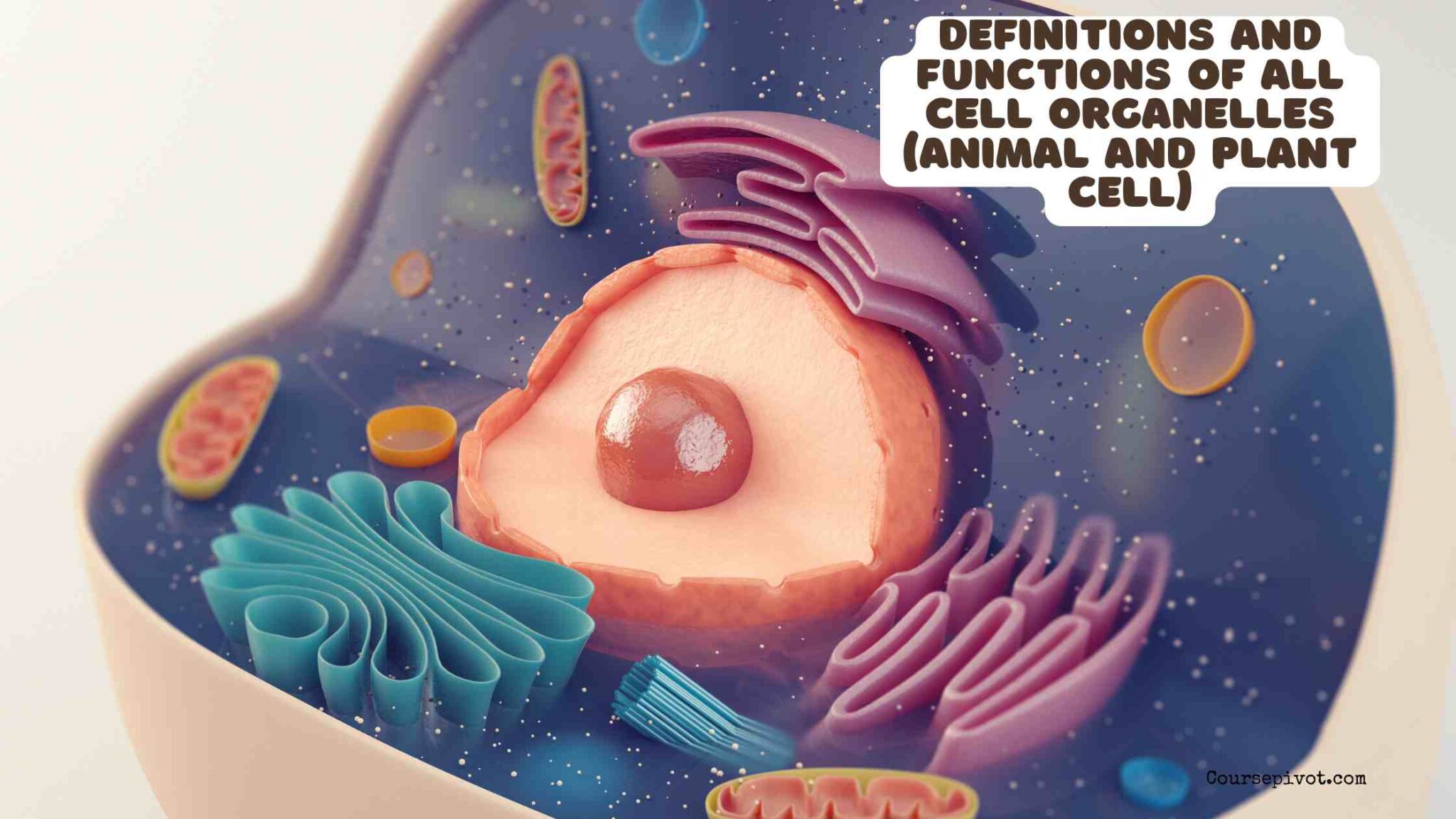
The definitions and functions of all cell organelles in animal and plant cells are easiest to understand when you see the cell as a working system. A cell is not just a bag of fluid. It is a small living unit with specialized parts that store instructions, make proteins, release energy, move materials, digest waste, and protect the cell from damage.
Plant and animal cells share many organelles because both are eukaryotic cells. That means they have a true nucleus and membrane-bound internal structures. But plant cells also have special structures, such as chloroplasts, a large central vacuole, and a cell wall, that help them make food, store water, and stay rigid.
Organelles are specialized cell structures with specific jobs, just like organs are specialized body structures with specific jobs.
What Is a Cell Organelle?
A cell organelle is a structure inside a cell that performs a particular function. Some organelles are surrounded by membranes, such as the nucleus, mitochondria, endoplasmic reticulum, Golgi apparatus, lysosomes, vacuoles, and chloroplasts. Others, such as ribosomes and the cytoskeleton, are not membrane-bound but are still essential cell structures.
In simple terms, organelles divide the work of the cell. This makes the cell more efficient. Instead of every process happening randomly in the cytoplasm, each major task has a place where it can happen properly.
The main jobs of organelles include:
- Storing genetic information.
- Making proteins.
- Producing energy.
- Packaging and transporting materials.
- Breaking down waste.
- Supporting cell shape.
- Storing water, food, and chemicals.
- Controlling what enters and leaves the cell.
Organelles Found in Both Animal and Plant Cells
Animal and plant cells share the core organelles needed for eukaryotic life. These shared structures allow both types of cells to grow, repair themselves, use energy, and reproduce.
| Organelle | Definition | Main function |
|---|---|---|
| Cell membrane | Thin, flexible boundary around the cell | Controls what enters and leaves the cell |
| Cytoplasm | Jelly-like fluid inside the cell | Holds organelles and allows many chemical reactions |
| Nucleus | Membrane-bound control center containing DNA | Stores genetic instructions and controls cell activities |
| Nucleolus | Dense region inside the nucleus | Makes ribosomal RNA and helps assemble ribosome parts |
| Ribosomes | Tiny structures made of RNA and protein | Build proteins from amino acids |
| Rough endoplasmic reticulum | Membrane network covered with ribosomes | Makes and folds proteins for export or membranes |
| Smooth endoplasmic reticulum | Membrane network without ribosomes | Makes lipids, detoxifies chemicals, and stores calcium |
| Golgi apparatus | Stack of flattened membrane sacs | Modifies, sorts, and packages proteins and lipids |
| Mitochondria | Bean-shaped organelles with folded inner membranes | Release energy from food during cellular respiration |
| Cytoskeleton | Network of protein fibers | Gives shape, support, movement, and internal organization |
| Vesicles | Small membrane sacs | Transport materials around the cell |
| Peroxisomes | Small enzyme-filled organelles | Break down fatty acids and harmful peroxide compounds |
These organelles work together constantly. For example, the nucleus contains DNA instructions. Ribosomes use those instructions to make proteins. The rough ER helps fold and process many proteins. The Golgi apparatus modifies and packages them. Vesicles then carry them to where they need to go.
For a deeper look at how DNA-related enzymes work during cell division, the article on enzymes in DNA replication explains how molecular machines copy genetic information before cells divide.
Plant Cell Organelles and Structures
Plant cells have several structures that animal cells do not have. These structures help plants make their own food, store water, maintain shape, and survive without moving from place to place.
| Plant cell structure | Definition | Main function |
|---|---|---|
| Cell wall | Rigid outer layer made mainly of cellulose | Supports, protects, and gives plant cells a fixed shape |
| Chloroplasts | Green organelles containing chlorophyll | Carry out photosynthesis to make glucose from light energy |
| Large central vacuole | Large fluid-filled sac in mature plant cells | Stores water, maintains turgor pressure, and supports the cell |
| Plasmodesmata | Tiny channels through plant cell walls | Allow communication and transport between neighboring plant cells |
The cell wall is one of the clearest differences between plant and animal cells. Animal cells have only a flexible cell membrane, but plant cells have a cell wall outside the membrane. This gives plant tissues strength and helps plants stand upright.
The chloroplast is another major plant cell feature. Chloroplasts contain chlorophyll, the green pigment that absorbs light energy. During photosynthesis, chloroplasts use light energy, carbon dioxide, and water to make glucose and oxygen.
The large central vacuole helps plant cells stay firm. When the vacuole is full of water, it presses outward against the cell wall. This pressure is called turgor pressure, and it helps leaves and stems stay upright.
Animal Cell Organelles and Structures
Animal cells do not have cell walls, chloroplasts, or one large central vacuole. Instead, they rely on flexibility, specialized tissues, and several organelles that are especially important in animal cells.
| Animal cell structure | Definition | Main function |
|---|---|---|
| Lysosomes | Enzyme-filled sacs common in animal cells | Digest waste, old organelles, and unwanted materials |
| Centrioles | Cylindrical structures made of microtubules | Help organize spindle fibers during animal cell division |
| Small vacuoles | Small storage sacs | Store or move water, nutrients, and waste |
| Cilia | Short hair-like projections on some cells | Move fluid or particles across the cell surface |
| Flagella | Long whip-like projection on some cells | Move the whole cell, such as a sperm cell |
Lysosomes are often called the recycling centers of animal cells. They contain digestive enzymes that break down worn-out organelles, food particles, and harmful materials. Plant cells can also perform breakdown and recycling through vacuoles and lytic compartments, but lysosomes are especially emphasized in animal cells.
Centrioles help animal cells divide properly. During cell division, they help organize the spindle fibers that pull chromosomes apart. Plant cells can still divide without typical centrioles, using other microtubule-organizing systems.
Animal cells are usually more flexible in shape than plant cells because they do not have rigid cell walls. This flexibility helps animal cells form tissues, move, change shape, and specialize for many different functions.
Animal Cell vs Plant Cell Organelles
The easiest way to compare animal and plant cells is to separate the shared organelles from the structures that are unique or especially important in one type.
| Feature | Animal cell | Plant cell |
|---|---|---|
| Cell membrane | Present | Present |
| Cell wall | Absent | Present |
| Nucleus | Present | Present |
| Ribosomes | Present | Present |
| Mitochondria | Present | Present |
| Chloroplasts | Absent | Present |
| Vacuoles | Small and often several | Usually one large central vacuole |
| Lysosomes | Common and well developed | Less typical; vacuoles often handle digestion |
| Centrioles | Usually present | Usually absent in higher plants |
| Shape | Flexible and variable | More fixed and box-like |
Both animal and plant cells need energy. Animal cells get usable energy by breaking down food molecules in mitochondria. Plant cells also use mitochondria, even though they have chloroplasts. Chloroplasts make glucose, but mitochondria still help release usable energy from that glucose.
That point is important: plant cells perform both photosynthesis and cellular respiration, while animal cells perform cellular respiration but not photosynthesis.
How Cell Organelles Work Together
Organelles do not work alone. A cell survives because its parts cooperate.
Imagine a secreted protein, such as a hormone or enzyme, being made inside a cell:
- The nucleus stores the DNA instructions for the protein.
- A copy of the instruction is made as messenger RNA.
- A ribosome reads the message and builds the protein.
- The rough ER helps fold and process the protein.
- A vesicle carries the protein to the Golgi apparatus.
- The Golgi apparatus modifies, labels, and packages the protein.
- Another vesicle moves it to the cell membrane.
- The cell membrane releases it outside the cell.
Energy for many of these steps comes from ATP, which is made mainly in the mitochondria. Support and movement inside the cell depend on the cytoskeleton. Waste from damaged parts can be broken down by lysosomes, vacuoles, or related recycling systems.
This cooperation is why cell biology is not just memorizing names. The real understanding comes from seeing how the parts connect.
Quick Study Guide for Cell Organelles
If you are studying cell organelles for school, start by grouping them by function instead of memorizing a random list.
| Function | Organelles involved |
|---|---|
| Control and information | Nucleus, nucleolus, chromosomes |
| Protein production | Ribosomes, rough ER, Golgi apparatus, vesicles |
| Energy | Mitochondria, chloroplasts in plants |
| Storage | Vacuoles, vesicles |
| Digestion and recycling | Lysosomes, vacuoles, peroxisomes |
| Support and shape | Cytoskeleton, cell wall in plants |
| Transport and boundaries | Cell membrane, ER, Golgi apparatus, vesicles |
This grouping helps you answer exam questions more clearly. If a question asks about protein transport, think ribosome, rough ER, Golgi apparatus, vesicle, and cell membrane. If a question asks why plant cells stay rigid, think cell wall and central vacuole.
Cell structure also connects to bigger biology ideas. For example, the article on why diffusion is insufficient in multicellular organisms explains why cells in large organisms need transport systems instead of relying on diffusion alone.
The Bottom Line
Cell organelles are specialized structures that help plant and animal cells stay alive. Some organelles, such as the nucleus, mitochondria, ribosomes, ER, Golgi apparatus, cytoplasm, and cell membrane, are found in both plant and animal cells. Others are more specific: plant cells have a cell wall, chloroplasts, plasmodesmata, and a large central vacuole, while animal cells commonly have lysosomes, centrioles, cilia, and flagella.
The most important thing is not just knowing each name. It is understanding each job. Once you know what each organelle does, the cell stops looking like a diagram to memorize and starts looking like a living system.